Client:
Medium:
Published:
Wirtschaftswoche
Editorial
2026
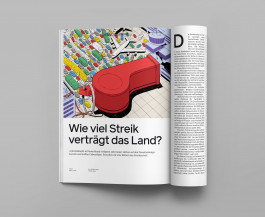
This editorial illustration was created for issue 19 of the German business magazine WirtschaftsWoche. The article discusses Germany’s strike laws and asks whether strikes in sectors like public transport, airports, or healthcare should face stronger restrictions when they heavily affect public life and the economy.
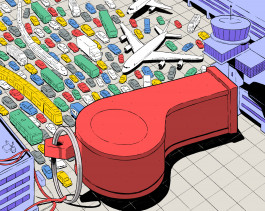
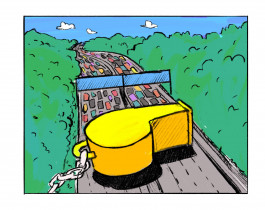
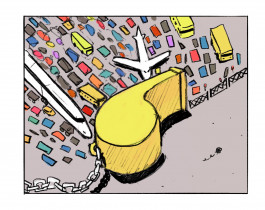
For the illustration, I developed the image of a giant red whistle blocking traffic from above. Cars, buses, trains, and airplanes pile up behind it, creating a complete standstill. The whistle acts both as a symbol of protest and as a physical barrier interrupting the flow of infrastructure.
I was interested in the tension at the center of the debate: strikes are disruptive by design. The inconvenience and economic pressure are part of their function. Editorial projects like this are always a balance between communicating the topic clearly while still leaving room for ambiguity and personal interpretation.


Sketches:


Client:
Medium:
Published:
Wirtschaftswoche
Editorial
2026
This editorial illustration was created for issue 19 of the German business magazine WirtschaftsWoche. The article discusses Germany’s strike laws and asks whether strikes in sectors like public transport, airports, or healthcare should face stronger restrictions when they heavily affect public life and the economy.
For the illustration, I developed the image of a giant red whistle blocking traffic from above. Cars, buses, trains, and airplanes pile up behind it, creating a complete standstill. The whistle acts both as a symbol of protest and as a physical barrier interrupting the flow of infrastructure.
I was interested in the tension at the center of the debate: strikes are disruptive by design. The inconvenience and economic pressure are part of their function. Editorial projects like this are always a balance between communicating the topic clearly while still leaving room for ambiguity and personal interpretation.


Sketch: